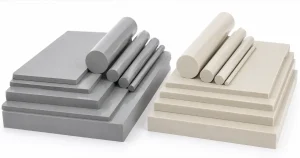
The molecular structure of PPS is simple, and the main chain of the molecule is alternately arranged by benzene rings and sulfur atoms. A large number of benzene rings endow PPS with rigidity, and a large number of thioether bonds provide flexibility. PPS has a symmetrical molecular structure and is easy to crystallize. It is a highly crystalline resin; it has good electrical properties due to its non-polarity and does not absorb water.
- (1) General performance
PPS is a white, high crystallinity (maximum crystallinity is 65%), hard and brittle polymer (similar to PS), the relative density of pure PPS is 1.3, but it will increase after modification. The water absorption of PPS is extremely small, generally only about 0.03%. The molding shrinkage of PPS is extremely small (0.1%~0.3% in the flow direction, 0.4%~0.8% in the vertical direction), the linear expansion coefficient is small (less than 3X10⁻⁵K-1), and the dimensional accuracy is tinily affected by temperature, humidity and external force. It has extremely high dimensional stability, and can manufacture high-precision plastic products.
Since the chemical structure of PPS contains 70% aromatic compounds and 30% elemental sulfur, it is inherently flame retardant, and its oxygen index is as high as 44%. The amount of smoke is much lower than that of other aromatic resins and halogen resins; compared with other plastics, it is a highly flame-retardant material in plastics, and has the highest combustion safety; other plastics with good flame retardancy include pure PVC with an oxygen index of 47%, PSF is 30%, PA66 is 29%, MPPO is 28%, and PC is 25%.
- (2) Mechanical properties
The mechanical properties of pure PPS are not high, especially the impact strength is relatively low. However, after glass fiber reinforcement, it will be greatly improved, and the tensile strength will be doubled from 67MPa to 137MPa; the impact strength will be increased by 3 times from 27J/m to 76J/m. In addition to glass fiber reinforcement to improve the impact strength of PPS, there are other methods to improve the impact strength, the comparison of different methods is shown in the table below.

PPS has high rigidity and has a rigid feeling similar to metal, which is rare in engineering plastics and can widely replace metal. The flexural modulus of pure PPS can reach 3.8GPa, and after inorganic filling modification, it can reach 12.6GPa, an increase of 3 times; after carbon fiber reinforcement, it can reach 22GPa, an increase of 5 times. The PPO known for its rigidity is only 2.55GPa, and the PC is only 2.1GPa.
PPS has good creep resistance and high hardness under load. The wear resistance of PPS is also high. Its wear amount at 1000 rpm is only 0.04g, and it will be greatly improved after filling with carbon fiber, F4 and molybdenum disulfide. PPS also has some self-lubricating properties and excellent fatigue resistance.
The mechanical properties of PPS have little sensitivity to temperature.
- (3) thermal properties
PPS has excellent thermal performance, can withstand high temperature of 260℃in a short period of time, and can be used for a long time at 200~240℃; its heat resistance is equivalent to that of PI, second only to F4 plastics, which is rare in thermosetting plastics. The solder heat resistance of PPS is excellent, and the solder heat resistance of polyphenylene sulfide is shown in the table below.
| Solder heat resistance of polyphenylene sulfide | ||
| engineering plastics | Solder heat resistance temperature/℃ | |
| 2s | 5s | |
| 40%GFPPS | 400 | 300 |
| 65%GFPPS | 400 | 300 |
- (4) electrical properties
The electrical properties of PPS are extremely outstanding. Compared with other engineering plastics, its dielectric constant and dielectric loss are relatively low, and it does not change much in a large frequency, temperature and humidity range. It can be used in high frequency, high humidity and used under harsh conditions such as high temperature; PPS has good arc resistance, which is comparable to thermosetting plastics.
PPS is often used in electrical insulation materials, and its usage can account for about 30%.
- (5) Environmental performance
One of the biggest features of PPS is its good chemical corrosion resistance, its chemical stability is second only to F4, comparable to F4; PPS is resistant to most acids, alkalis, salts, esters, ketones, aldehydes, phenols, aliphatic hydrocarbons, aromatic Hydrocarbons and chlorinated hydrocarbons, etc., but it is not resistant to chlorinated biphenyls and oxidizing acids, oxidants, concentrated sulfuric acid, concentrated nitric acid, aqua regia, ammonia peroxide and sodium hypochlorite at high temperatures, and PPS cannot be used in oxidizing acids for a long time (e.g. hot nitric acid). So far, no solvent that can dissolve PPS below 200℃ has been found.
PPS has good radiation resistance and is stable under cobalt 60 rays and gamma rays. PPS has good weather resistance, and the specific performance is shown in the table below.
| Performance of PPS | ||
| performance | PPS(R-4) | PPS(R-8) |
| Relative density | 1.6 | 1.8 |
| water absorption/% | <0.05 | <0.03 |
| Molding shrinkage/% | <0.12 | <0.12 |
| Tensile Strength/MPa | 137 | 98 |
| elongation at break/% | 1.3 | 0.8 |
| Bending strength/MPa | 204 | 144 |
| Flexural modulus/GPa | 11.9 | 12.6 |
| Notched impact strength/(J/m) | 76 | 27 |
| Heat distortion temperature(1.81MPa)/℃ | >260 | >260 |
| No-load continuous use temperature/℃ | 260 | 260 |
| Linear expansion coefficient/(X 10–5K-1) | 3 | <3 |
| hardness | R132 | R121 |
| Dielectric strength/(kV/mm) | 18 | 13.6 |
| Dielectric constant(103Hz) | 3.9 | 4.6 |
| volume resistivity/Ω·cm | 1016 | 1015 |
| Dielectric loss tangent(103Hz) | 1.3X10³ | 1.7X10³ |
| Oxygen Index/% | 44 | 53 |
| arc resistance/s | 120 | 190 |