When engineering custom, non-standard plastic parts, material selection dictates product longevity. But when evaluating datasheets, which mechanical property should lead your design: Tensile Strength or Flexural Modulus?
Introduction to Plastic Mechanical Properties
In the realm of custom plastic manufacturing, selecting the ideal polymer formula involves balancing multiple technical parameters. Two of the most frequently cross-referenced metrics on material datasheets are Tensile Strength and Flexural Modulus. While they both evaluate how a plastic material reacts under mechanical stress, they simulate fundamentally different structural environments.
For product designers, procurement officers, and engineers dealing with non-standard or bespoke plastic components, misunderstanding these terms can lead to catastrophic field failures—either through brittle snapping or excessive deformation. Let’s break down each metric to determine which one matters most for your specific application.
What is Tensile Strength in Plastics?
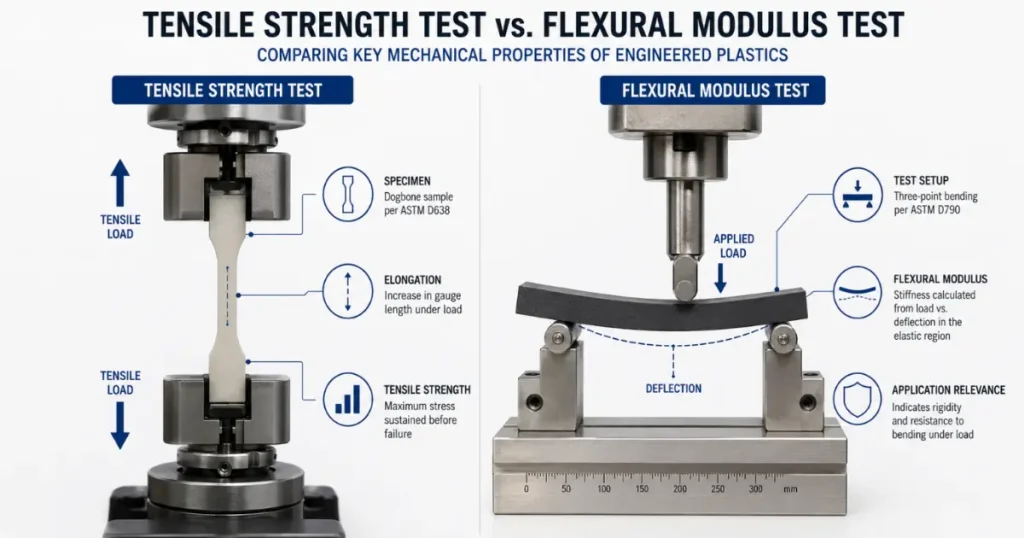
Tensile strength measures a polymer’s resistance to being pulled apart. Tested under standards like ASTM D638 or ISO 527, a plastic specimen is clamped at both ends and pulled in opposite directions until it yields or breaks.
- Tensile Strength at Yield: The point where plastic deformation becomes permanent.
- Tensile Strength at Break: The ultimate stress the material withstands right before fracturing.
When it matters most: Tensile strength is vital for components experiencing direct pulling or tension, such as heavy-duty plastic fasteners, zip ties, gears, and structural anchor points.
What is Flexural Modulus in Plastics?
Flexural modulus measures a material’s stiffness when subjected to bending forces. Conducted via ASTM D790 or ISO 178, a plastic bar is placed on two supports, and a loading nose applies force to the center (3-point bending test). The flexural modulus represents the ratio of stress to strain within the elastic limit.
Unlike tensile properties, which look at pure elongation, flexural modulus combines elements of compression, tension, and shear forces simultaneously as the outer surface stretches and the inner surface compresses.
When it matters most: Flexural modulus is the key metric for load-bearing profiles, structural enclosures, plastic shelving, automotive panels, and any custom non-standard component that must resist sagging or warping under weight.
Technical Comparison: Tensile Strength vs. Flexural Modulus
To help you optimize your material selection for non-standard configurations, the table below showcases how standard versus reinforced custom polymers compare across these two key metrics.
| Material Class (Custom Formulations) | Tensile Strength (MPa) | Flexural Modulus (GPa) | Primary Stress Type Resisted | Best Suited Non-Standard Applications |
|---|---|---|---|---|
| Standard Polypropylene (PP) | 25 – 40 | 1.1 – 1.6 | Moderate Tension / High Flexibility | Living hinges, custom containers, packaging lids |
| ABS (Acrylonitrile Butadiene Styrene) | 35 – 50 | 2.1 – 2.7 | Impact & Moderate Torsion | Electronic housings, custom bezels, prototypes |
| Nylon 6 (PA6) – Unfilled | 60 – 85 | 2.3 – 3.2 | High Dynamic Pulling Stress | Industrial gears, sliding bushes, rollers |
| Nylon 66 (PA66) – 30% Glass Fiber Reinforced | 130 – 185 | 7.5 – 10.5 | Extreme Structural Loads & Sags | Automotive engine shrouds, heavy-duty structural brackets |
| Polycarbonate (PC) – High Impact | 55 – 75 | 2.2 – 2.5 | High Tensile & Impact Resistance | Protective shields, optical components, custom guards |
Which Indicator is More Important?
The short answer is: Neither is universally more important; your application’s loading environment determines the priority.
- Choose Tensile Strength First if your part functions under direct axial loads (pulling, stretching, suspending weights). High tensile strength prevents the part from necking or snapping under a straight pull.
- Choose Flexural Modulus First if your part acts as a beam, shelf, outer shell, or protective barrier. High flexural modulus guarantees the part will maintain its structural aesthetics and geometric tolerances without bending out of shape.
For complex non-standard plastic profiles, engineering teams often leverage modified formulas—blending glass fibers or carbon additives—to maximize both metrics simultaneously, ensuring high rigidity and high structural yield strength.
Custom & Non-Standard Plastic Engineering with Quanda Plastic
At Quanda Plastic, we specialize in tailoring material properties to meet precise industrial requirements. Standard off-the-shelf polymer specifications rarely meet the rigorous demands of custom industrial designs. Whether you need an optimized flexural modulus to prevent structural deformation or enhanced tensile strength for extreme cyclic loading, our team designs custom compounds and extruded profiles tailored to your specifications.
Ready to select the perfect polymer matrix for your custom non-standard design? Contact our plastic engineering specialists today for a technical consultation and data validation.
Frequently Asked Questions (FAQ)
1. Can a plastic have high tensile strength but low flexural modulus?
Yes. Elastomeric materials or highly specialized tough polymers can withstand immense pulling force before tearing (high tensile strength) but can bend very easily under minimal vertical load (low flexural modulus). Nylon with certain plasticizers exhibits similar behavior.
2. How does temperature affect tensile strength and flexural modulus?
As temperature rises, both tensile strength and flexural modulus generally decrease because polymer chains become more mobile. Conversely, in sub-zero environments, plastics become stiffer (higher modulus) but more brittle (susceptible to impact failure).
3. Why are non-standard plastic products tested differently?
Non-standard or custom-extruded plastics often incorporate custom fiber orientations or specialized additives. Testing standard raw pellets doesn’t always reflect final part performance, making customized structural simulation critical.
4. What does a higher flexural modulus indicate?
A higher flexural modulus directly translates to a stiffer material. It indicates that the plastic will resist bending, deflection, and sagging when a load is applied perpendicular to its length.