The oil and gas industry operates under some of the most punishing environments on Earth. From deepwater offshore drilling to high-pressure, high-temperature (HPHT) downstream refining, equipment components are constantly exposed to corrosive fluids, sour gas (H₂S), abrasive chemicals, and extreme mechanical stresses. In these critical applications, standard elastomeric seals and conventional piping materials quickly degrade, leading to catastrophic equipment failure, costly downtime, and environmental hazards.
To mitigate these risks, global oilfield service companies are increasingly turning to advanced engineering thermoplastics. Specialized fluoropolymers, particularly Polytetrafluoroethylene (PTFE), have become the gold standard. In this article, we explore how high-pressure, chemical-resistant plastic seals and tubes optimize uptime, enhance safety, and extend the lifespan of critical oilfield assets.
1. PTFE Spring-Energized Seals: Eliminating Leaks under Extreme HPHT
Traditional rubber seals suffer from explosive decompression (ED) and chemical hardening when exposed to high-pressure gases. PTFE Spring Seals (also known as spring-energized lip seals) solve this problem entirely.
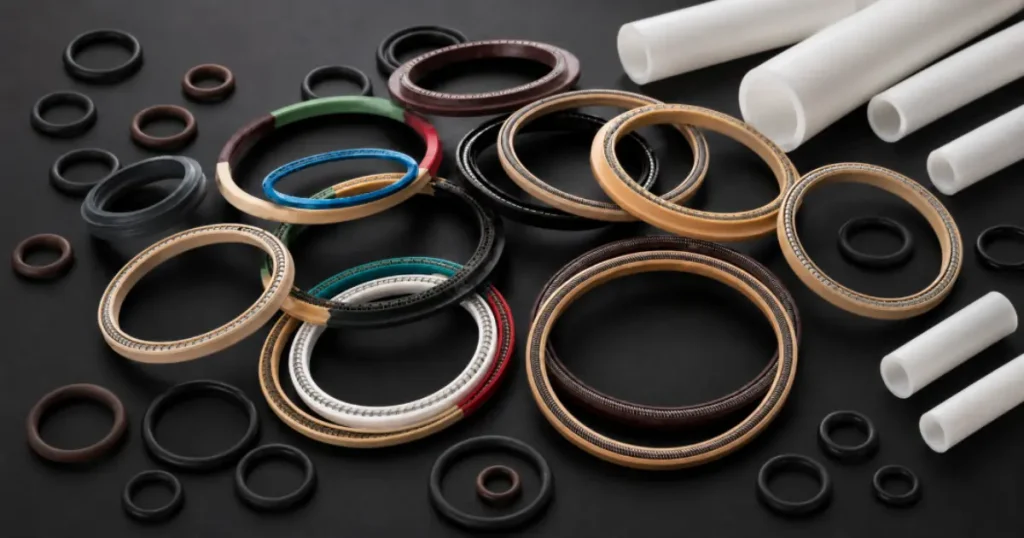
These seals utilize a corrosion-resistant metal spring (such as Elgiloy or Hastelloy) embedded inside a U-shaped PTFE jacket. When pressure increases, the system’s fluid pressure assists the spring, pushing the sealing lips tightly against the mating surfaces. This design ensures a gas-tight seal even during thermal cycling or pressure drops.

Figure 1: Custom-engineered PTFE spring-energized seals for extreme pressure barriers.
- Key Benefit: Zero stick-slip, excellent wear resistance, and immunity to Rapid Gas Decompression (RGD).
- Common Applications: Downhole drilling tools, subsea valves, Christmas trees, and blowout preventers (BOPs).
2. PTFE O-Rings: Universal Chemical Inertness for Static & Dynamic Seals
While standard elastomeric O-rings swell or degrade when contacting aggressive solvents, drilling muds, or sour chemicals, PTFE O-Rings maintain their structural integrity. PTFE is chemically inert to almost all industrial chemicals, fluids, and gases.

Figure 2: Corrosion-resistant PTFE O-Rings for oil and gas fluid handling.
For applications requiring a balance between elasticity and chemical resistance, custom-filled PTFE (such as carbon, glass fiber, or bronze-filled) or encapsulated O-rings provide enhanced creep resistance and higher load-bearing capabilities under high-pressure conditions.
3. PTFE Tubes: Reliable Fluid Transfer and Control Line Protection
Beyond sealing, fluid transmission lines must also withstand corrosive downhole chemicals and extreme heat. PTFE Tubes are extensively used as lining materials, chemical injection lines, and umbilical control lines.

Figure 3: Durable, heavy-wall PTFE tubing for chemical injection lines.
With an extremely low coefficient of friction, PTFE tubes minimize pressure drops inside fluid lines and prevent the build-up of waxes, asphaltenes, or scale, which are major operational headaches in oil and gas extraction.
Technical Comparison: Materials for Critical Oil & Gas Applications
Choosing the right material configuration is essential for maximizing component life. Below is a comparative overview of how PTFE-based solutions outperform standard industrial sealing polymers:
| Product / Material Type | Max Pressure Rating | Temperature Range | Chemical Resistance | Primary Industry Application |
|---|---|---|---|---|
| PTFE Spring Seals | Up to 100+ MPa (Dynamic) | -200°C to +260°C | Universal (H₂S, CO₂, Drilling Muds) | Downhole Tools, Subsea Valves, BOPs |
| PTFE O-Rings | Up to 30 MPa (Static) | -150°C to +250°C | Universal (Except molten alkali metals) | Refinery Piping, Flanges, Pumps |
| PTFE Tubing | Depends on Wall Thickness | -70°C to +260°C | Excellent (Anti-scaling, Non-corrosive) | Chemical Injection, Wire Insulation |
| Standard NBR / Rubber | Low to Medium | -40°C to +120°C | Poor against aromatics & H₂S | Low-risk utility fluid handling |
Why Custom (Non-Standard) Components Are Crucial
In the oilfield, there is no such thing as “one size fits all.” Well depths, temperatures, and aggressive chemical compositions vary drastically from one block to another. Off-the-shelf polymer components often fail to meet exact tolerances or custom cross-sectional profiles required by modern smart wells.
Partnering with a specialized manufacturer allows you to customize raw material filler modifications (e.g., carbon-filled, glass-fiber-reinforced, or MoS₂-lubricated PTFE) and adjust dimensional geometries to fit non-standard valve housings and pipe diameters seamlessly.
Frequently Asked Questions (FAQ)
What makes PTFE superior to rubber in high-pressure oil and gas settings?
Unlike standard rubber or elastomers, PTFE does not suffer from Rapid Gas Decompression (RGD) or explosive decompression. It remains chemically inert when exposed to sour gases (H₂S) and heavy acids, ensuring it doesn’t swell, harden, or crack under extreme high-pressure, high-temperature (HPHT) conditions.
Can PTFE spring-energized seals handle dynamic rotational movements?
Yes. PTFE spring-energized seals have a very low coefficient of friction, meaning they generate minimal heat during movement. This makes them ideal for both slow-speed high-torque rotational applications and linear reciprocating actuators found in oilfield tools.
How do I order custom size non-standard PTFE seals or tubes?
Because oil and gas hardware often requires custom sizing, components are manufactured according to custom CAD prints and operational parameters (pressure, temperature, medium). You can consult engineering experts directly through our Contact Page to get precise quotes for tailored solutions.
Conclusion: Upgrade Your Oilfield Operational Reliability
Investing in precision-engineered high-pressure and chemical-resistant plastic seals and tubes is a proven strategy to avoid costly environmental penalties and unexpected downtime. Quanda Plastic specializes in manufacturing custom high-performance PTFE components tailored to the strict quality demands of the oilfield sector.
Ready to select the perfect compound or custom dimension for your next drilling or refining project? Contact Quanda Plastic’s Engineering Team today for expert support and quick-turnaround custom manufacturing.