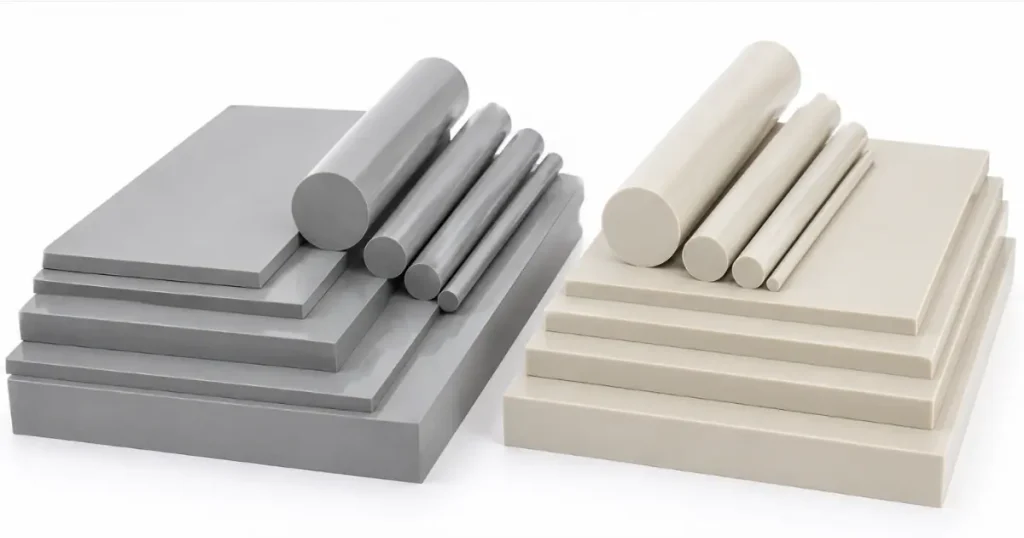
When specifying thermoplastics for harsh industrial environments, chemical processing systems, or fluid handling equipment, polymer selection often comes down to two dominant materials: Polyvinyl Chloride (PVC) and Chlorinated Polyvinyl Chloride (CPVC). While both materials belong to the vinyl family and share excellent inherent chemical inertness, subtle chemical structural variations result in drastically different thermal limits and aggressive medium handling capacities.
Selecting between these two engineered polymers requires evaluating continuous service temperatures, corrosive media exposure, mechanical rigidity, and overall life-cycle cost. In this technical comparison, we examine the practical engineering differences between Lasenic® PVC and Lasenic® CPVC stock shapes.
1. Molecular Structure: The Chlorination Differential
To understand performance discrepancies, one must examine the polymer chemistry:
- PVC (Polyvinyl Chloride): Composed of repeating vinyl chloride monomers with a standard chlorine concentration of approximately 56.7% by weight.
- CPVC (Chlorinated Polyvinyl Chloride): Produced by free-radical chlorination reaction of PVC homopolymer. This post-chlorination increases the base chlorine content up to 63% to 69%.
The addition of bulky chlorine atoms along the polymer backbone creates greater steric hindrance, restricting molecular chain mobility. This structural modification directly elevates the material’s Glass Transition Temperature (Tg), heat deflection under load, and flame retardation characteristics.
2. Temperature Resistance & Thermal Behavior
Thermal stability is the primary operational differentiator between unplasticized PVC and CPVC shapes in fluid handling, tank construction, and CNC machined component design.
Key Takeaway: Lasenic® PVC is optimal for ambient temperature chemical processing (up to 60°C / 140°F). For processes involving exothermic reactions, hot acid recirculation, or washdown systems reaching up to 95°C (203°F), Lasenic® CPVC is mandatory to prevent creep, sagging, or catastrophic pressure failure.
3. Chemical Compatibility Comparison
Both materials exhibit superior resistance to inorganic acids, bases, salts, and paraffinic hydrocarbons compared to polyolefins or metallic alloys. However, the higher chlorine content in CPVC delivers enhanced passivity against aggressive oxidizers and elevated-temperature chemistry.
Acid & Base Handling
While standard PVC handles dilute acids (hydrochloric acid, sulfuric acid up to 70%) exceptionally well at room temperature, CPVC excels when concentrations or temperatures rise. For example, CPVC handles up to 98% concentrated sulfuric acid and sodium hypochlorite solutions at elevated temperatures without stress cracking.
Solvents & Organics (Limitations)
Neither PVC nor CPVC should be used with strong polar solvents. Both materials are susceptible to severe swelling or dissolution when exposed to:
- Ketones (e.g., Acetone, MEK)
- Esters & Ethers (e.g., THF, Ethyl Acetate)
- Aromatic and Chlorinated Hydrocarbons (e.g., Benzene, Toluene, Methylene Chloride)
4. Mechanical Properties & Machinability
Both Lasenic® PVC and Lasenic® CPVC sheets and rods demonstrate high tensile modulus, excellent dimensional stability, and low coefficient of thermal expansion compared to PE or PP.
- Machining: Both materials can be readily turned, milled, drilled, and tapped using standard metalworking tooling. CPVC exhibits slightly higher hardness and notch sensitivity, requiring sharp carbide tooling and optimized cooling during deep drilling.
- Welding & Fabrication: Both stock shapes can be thermal hot-air welded, socket welded, or bonded. (Note: CPVC requires specific high-viscosity solvent cements formulated for elevated temperature service).
5. Technical Comparison Data Sheet
The table below summarizes standard physical, thermal, and mechanical values comparing premium grade Lasenic® PVC and Lasenic® CPVC stock shapes:
| Property Parameter | Testing Method | Lasenic® PVC Sheet & Rod | Lasenic® CPVC Sheet & Rod |
|---|---|---|---|
| Specific Gravity / Density | ASTM D792 | 1.40 – 1.45 g/cm³ | 1.50 – 1.55 g/cm³ |
| Max Continuous Working Temp | Internal Standard | 60°C / 140°F | 95°C / 203°F |
| Heat Deflection Temp (HDT @ 1.8 MPa) | ASTM D648 | 67°C – 72°C | 100°C – 110°C |
| Tensile Strength at Yield (23°C) | ASTM D638 | 50 – 55 MPa | 55 – 60 MPa |
| Flexural Modulus | ASTM D790 | 2,800 – 3,200 MPa | 3,000 – 3,500 MPa |
| Flammability Rating | UL 94 | V-0 | V-0 / 5VB |
| Thermal Conductivity | ASTM C177 | 0.15 W/m·K | 0.14 W/m·K |
6. Application Guidance: Making the Right Selection
Choosing the correct plastic material ensures long equipment service life while preventing costly downtime:
Choose Lasenic® PVC when:
- Operating temperatures remain strictly below 60°C (140°F).
- Budget efficiency is critical for large-scale ducting, plating tanks, or structural cladding.
- Handling ambient municipal water, general industrial effluent, or low-concentration chemical wash solutions.
Choose Lasenic® CPVC when:
- Working temperatures routinely exceed 60°C and approach 90°C–95°C.
- Handling hot concentrated acids, hot chlor-alkali solutions, or aggressive plating chemicals.
- Building hot fluid processing equipment, scrubbers, or thermal insulation barriers in semiconductor manufacturing lines.
Frequently Asked Questions (FAQ)
Q1: What is the primary operational difference between PVC and CPVC?
The primary difference is temperature endurance. CPVC undergoes post-chlorination, raising its heat deflection point and enabling continuous operation up to 95°C (203°F), compared to 60°C (140°F) for standard rigid PVC.
Q2: Is CPVC more chemically resistant than PVC?
At ambient temperatures, both show similar resistance to acids, bases, and salts. However, at elevated temperatures (above 50°C), CPVC retains high chemical resistance where standard PVC degrades, softens, or loses mechanical strength.
Q3: Can Lasenic® PVC and CPVC be CNC machined into custom parts?
Yes. Both Lasenic® PVC and CPVC sheets and rods offer excellent dimensional stability and can be high-precision CNC turned, routed, milled, and drilled into custom manifold blocks, valve bodies, structural bushings, and semiconductor housings.
Need Material Assistance or Custom Machining Quotes?
At QUANDA Plastic, we stock high-grade Lasenic® PVC and Lasenic® CPVC sheets and rods, providing custom cut-to-size service and precision CNC machining tailored to your engineering specifications.