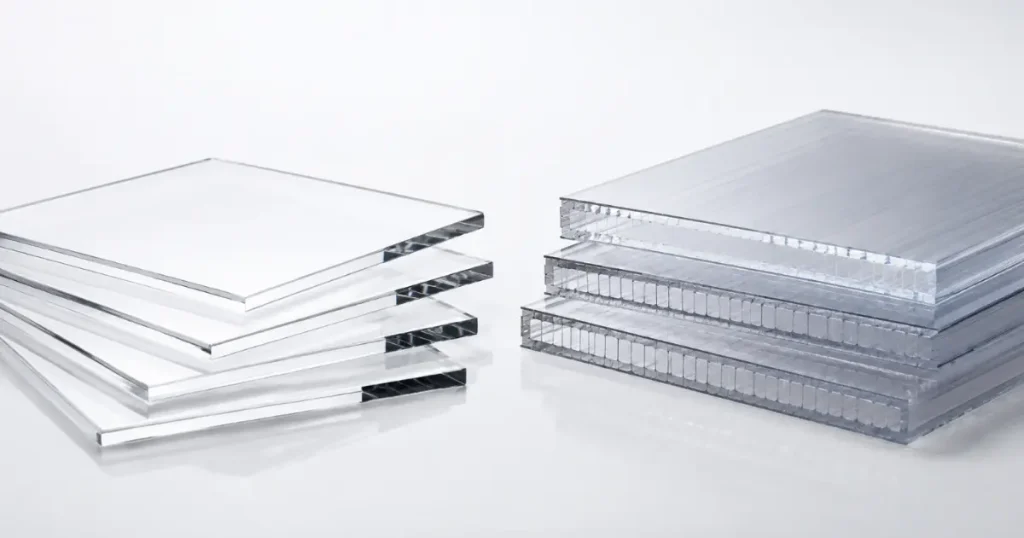
When it comes to selecting transparent plastic materials for industrial, commercial, or structural applications, two names consistently dominate the market: Acrylic (PMMA) and Polycarbonate (PC). While they look almost identical at a first glance, their physical properties, strengths, and ideal use cases are worlds apart.
Choosing the wrong material can lead to costly project failures—whether it’s a cracked window due to lack of impact resistance or a yellowed outdoor display caused by poor UV stability. In this ultimate guide, we will break down the technical differences between PMMA and PC to help you make an informed decision for your custom fabrication needs.
What is Acrylic (PMMA)?
Polymethyl Methacrylate (PMMA), commonly known as Acrylic, is a synthetic resin prized for its exceptional optical clarity, rigid structure, and outstanding weatherability. It serves as an excellent, lightweight alternative to glass. At Quanda Plastic, our premium Lasenic® PMMA sheet and rod delivers high gloss, scratch resistance, and superior UV performance, making it the go-to choice for aesthetic and outdoor displays.
What is Polycarbonate (PC)?
Polycarbonate (PC) is a naturally transparent amorphous thermoplastic. Its defining characteristic is virtually unbreakable toughness. It possesses an impact strength hundreds of times greater than standard glass. Our high-performance Benlonate® PC sheet and rod is engineered for heavy-duty industrial environments, security glazing, and precision-machined non-standard components where safety and durability cannot be compromised.
Technical Comparison: PMMA vs. PC
To help your engineering team quickly evaluate these materials, here is a direct technical comparison highlighting the key performance metrics of both transparent sheets:
| Property / Feature | Lasenic® PMMA (Acrylic) | Benlonate® PC (Polycarbonate) |
|---|---|---|
| Optical Clarity / Light Transmision | Excellent (~92%, clearer than glass) | Very Good (~88% to 89%) |
| Impact Resistance | Moderate (17x more resistant than glass) | Extreme (Up to 250x more resistant than glass; virtually bulletproof) |
| Scratch Resistance | High (Harder surface, easy to polish out scratches) | Low (Softer surface, prone to scratching unless coated) |
| UV & Weather Stability | Excellent (Naturally UV stable, won’t yellow easily outdoors) | Moderate (Requires UV-stabilized coating for prolonged outdoor exposure) |
| Machinability & Fabrication | Great for laser cutting and thermoforming; brittle when drilling edges | Highly flexible; can be cold-bent without cracking; perfect for drilling/machining |
| Continuous Service Temp | Up to 70°C to 80°C | Up to 115°C to 120°C |
How to Choose? Core Decision Factors
Choose Lasenic® PMMA (Acrylic) If:
- You need maximum light transmission, brilliant gloss, and high-end aesthetics (e.g., retail displays, signages, premium aquariums).
- The product will be exposed to long-term sunlight and weather, and you want to prevent yellowing.
- Your fabrication involves intricate laser cutting or engraving.
Choose Benlonate® PC (Polycarbonate) If:
- Impact protection and safety are your top priorities (e.g., machine guards, security shields, structural glazing).
- The material needs to withstand extreme operating temperatures or harsh industrial environments.
- The components require complex drilling, CNC machining, or cold-bending on-site.
Looking for Custom Non-Standard Transparent Solutions?
Every industrial application comes with its unique dimensions, tolerances, and environment demands. At Quanda Plastic, we specialize in supplying high-quality extrusion and cast plastic sheets customized to your exact blueprints.
Whether you need a specific thickness of Benlonate® PC for high-stress machinery enclosures or precision-cut Lasenic® PMMA for high-clarity optical barriers, our engineering team is here to support you from material selection to final delivery.
Ready to jumpstart your next project? Contact Quanda Plastic Specialists today for professional technical consulting and a competitive quote!
Frequently Asked Questions (FAQ)
1. Which is easier to scratch: Acrylic or Polycarbonate?
Acrylic (PMMA) has a harder surface gloss and is significantly more scratch-resistant than Polycarbonate (PC). If Polycarbonate gets scratched, it cannot be easily buffed out, whereas Acrylic can be polished back to a crystal-clear finish.
2. Can Polycarbonate (PC) be used outdoors without turning yellow?
Standard Polycarbonate will gradually yellow and degrade under direct sunlight due to UV radiation. However, specialized, UV-stabilized polycarbonate sheets (like certain grades of our Benlonate® PC) are engineered with protective layers to withstand outdoor weathering without yellowing for years.
3. Is Acrylic or Polycarbonate better for laser cutting?
Acrylic (PMMA) is the absolute winner for laser cutting. It cuts cleanly, leaving a highly polished, smooth flame edge. Polycarbonate, on the other hand, absorbs laser heat poorly, which often results in charring, discoloration, and toxic fumes; it is better processed via CNC routing or mechanical sawing.
4. Are these sheets available in custom, non-standard dimensions?
Yes. Beyond standard stock sizes, Quanda Plastic provides comprehensive customization services for both Benlonate® PC and Lasenic® PMMA sheets and rods, tailored precisely to meet the strict technical tolerances of your non-standard components.