Discover the technical differences between Sufoner® PSU and Sufoner® PEI high-performance thermoplastics. Compare thermal performance, mechanical strength, chemical resistance, and machining applications for custom non-standard plastic parts.
When engineering high-precision components for demanding aerospace, medical, automotive, and semiconductor applications, selecting the right high-performance thermoplastic is critical. Among transparent heat-resistant engineering plastics, Polysulfone (PSU) and Polyetherimide (PEI) stand out as top-tier solutions due to their superior thermal stability, excellent mechanical strength, flame retardancy, and optical clarity.
At Quanda Plastic, we manufacture and machine high-grade Sufoner® PSU and Sufoner® PEI stock shapes (rods, sheets, tubes) and custom non-standard CNC machined parts tailored to your specific industrial requirements.
1. Overview of Sufoner® PSU and Sufoner® PEI

Sufoner® PSU (Polysulfone)
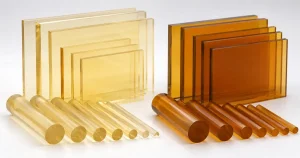
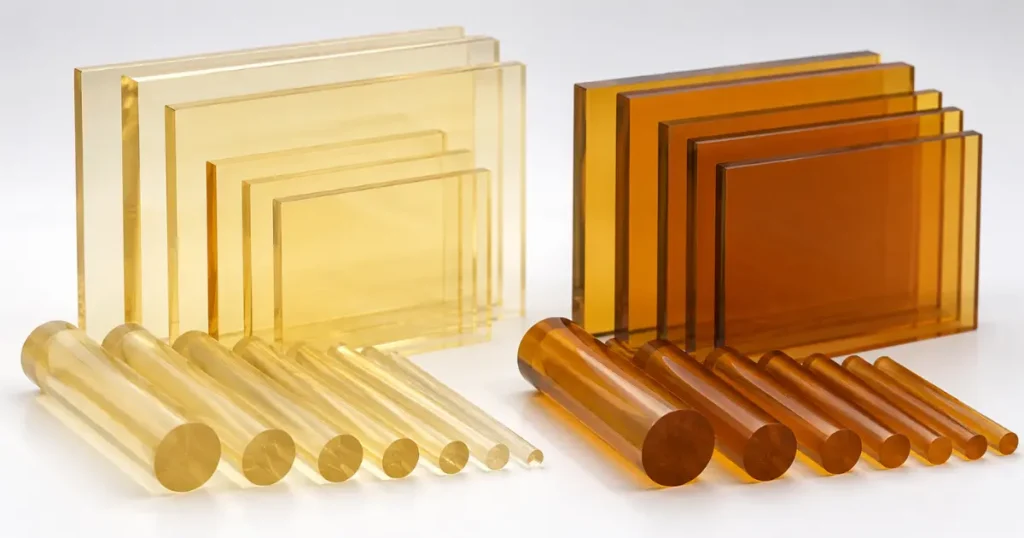
Sufoner® PSU is an amber-tinted semi-transparent rigid thermoplastic known for its high hydrolytic stability and thermal resistance. It performs continuously in steam and hot water environments up to 160°C (320°F) and exhibits exceptional dimensional stability and electrical insulation properties.

Sufoner® PEI (Polyetherimide)
Sufoner® PEI (commonly Ultem® equivalent) is an amorphous transparent amber high-performance polymer offering higher mechanical strength, tensile modulus, and continuous service temperature (up to 170°C / 338°F) than PSU. It exhibits inherent flame resistance (UL94 V-0) without additives and extremely low smoke emission.
2. Technical Property Comparison: PSU vs. PEI
Understanding the subtle property distinctions between PSU and PEI helps engineering teams select the most cost-effective and reliable material for custom non-standard components.
| Property | Sufoner® PSU (Polysulfone) | Sufoner® PEI (Polyetherimide) |
|---|---|---|
| Appearance & Clarity | Amber translucent / semi-transparent | Amber transparent |
| Density (g/cm³) | 1.24 | 1.27 |
| Glass Transition Temp (Tg) | 190 °C | 217 °C |
| Heat Deflection Temp (HDT @ 1.8 MPa) | 174 °C | 200 °C |
| Continuous Service Temperature | 160 °C (320 °F) | 170 °C (338 °F) |
| Tensile Strength at Yield (MPa) | ~70 – 80 MPa | ~100 – 110 MPa |
| Flexural Modulus (GPa) | ~2.6 GPa | ~3.3 GPa |
| Flammability Rating | UL 94 HB (V-0 custom grades available) | Inherent UL 94 V-0 (without additives) |
| Steam / Hydrolysis Resistance | Outstanding (repeated autoclaving) | Excellent (susceptible to long-term high pressure steam under stress) |
| Chemical Resistance | Resistant to mineral acids, alkalis, salt solutions; sensitive to polar solvents | Superior resistance to hydrocarbons, alcohols, halogenated solvents, and acids |
3. Key Differences Explained for Engineering Design
A. Thermal & Mechanical Superiority
While both materials are classified as high-temperature plastics, PEI offers approximately 25-30% higher tensile strength and flexural modulus than PSU. If your non-standard plastic component requires extreme load-bearing capability under elevated temperatures, Sufoner® PEI is the preferred structural material.
B. Hydrolytic Stability & Autoclave Cycles
For applications involving continuous exposure to hot water, steam sterilization, or repeated medical autoclaving, PSU exhibits higher hydrolytic stability over prolonged cyclic steam exposure compared to unreinforced PEI, making Sufoner® PSU a staple in medical devices and biotechnology fluid control manifolds.
C. Flame Retardancy and Smoke Generation
PEI possesses an inherently high Limiting Oxygen Index (LOI) and meets strict UL94 V-0 flame retardancy requirements natively without halogenated flame retardants. It complies with FAA aircraft interior flammability standards, making it the industry standard for aerospace interiors and electrical enclosures.
4. Custom Non-Standard Processing & Machining Solutions
At Quanda Plastic, we specialize in high-precision CNC machining and custom non-standard fabrication of engineering plastics. PSU and PEI require tight environmental controls and stress-relief post-processing to avoid environmental stress cracking (ESC).
- Custom Rod & Sheet Extrusion: Custom diameters, sheet thicknesses, and tight-tolerance stock shapes.
- Precision CNC Turning & Milling: Micro-machining and complex geometries for optical sight glasses, valve blocks, and connectors.
- Annealing & Stress Relieving: Thermal post-curing cycles to eliminate internal stress and guarantee long-term dimensional precision.
Have a custom project blueprint or non-standard plastic drawing? Contact our technical engineering team for an instant CAD quote.
5. Frequently Asked Questions (FAQ)
Q1: Is PSU cheaper than PEI?
Answer: Yes, Polysulfone (PSU) generally has a lower raw material cost compared to Polyetherimide (PEI). When design specifications allow for lower mechanical modulus and maximum continuous temperatures below 160°C, Sufoner® PSU serves as a highly cost-effective alternative.
Q2: Can PSU and PEI transparent plastics be polished to optical clarity?
Answer: Yes. Both Sufoner® PSU and Sufoner® PEI can be machined, vapor polished, or mechanically polished to achieve high optical transparency for flow meters, sight glasses, and fluidic manifolds.
Q3: Which plastic is better for medical autoclave sterilization?
Answer: Both materials tolerate steam autoclaving; however, Sufoner® PSU is widely preferred for repeated hot-water and steam sterilization cycles due to its superior hydrolytic stability and resistance to stress whitening in moist environments.
Q4: Does Quanda Plastic supply custom non-standard machined parts according to drawings?
Answer: Yes, Quanda Plastic provides complete OEM/ODM customized fabrication services. We machine non-standard components directly from your 2D/3D CAD drawings (STEP, IGES, DWG) using advanced 3-axis and 5-axis CNC machining equipment.