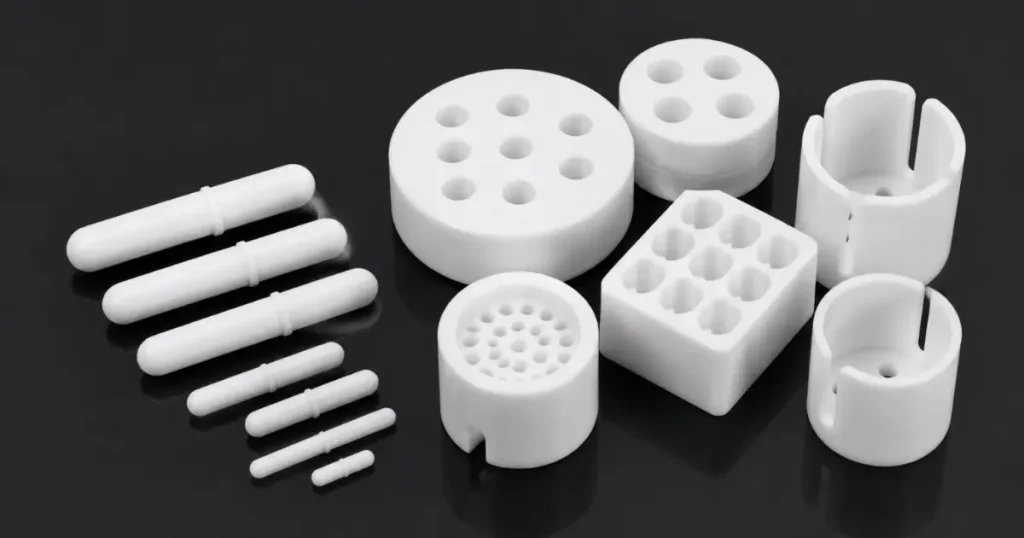
To address these critical challenges, premium fluoropolymers have become the gold standard. Among them, custom-machined PTFE laboratory equipment—specifically PTFE stirring bars and PTFE sample holders—offers an unparalleled combination of chemical inertness, thermal endurance, and durability.
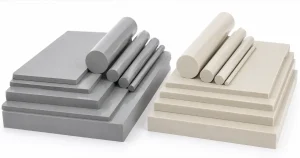
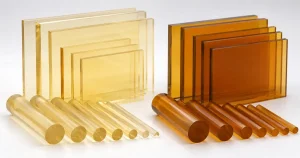
At Quanda Plastic, we manufacture these high-demand components utilizing our premium Saferlon® PTFE Sheet & Rod, ensuring that every non-standard lab tool meets stringent industry tolerances.
Why PTFE is Essential for High-Purity Lab Environments
Polytetrafluoroethylene (PTFE) possesses unique molecular structures that make it uniquely suited for rigorous lab applications. When machined into critical components like stirring bars, racks, and sample holders, it provides several key performance advantages:
- Universal Chemical Inertness: PTFE is virtually unreactive to almost all chemicals, including hydrofluoric acid, aqua regia, and highly concentrated alkaline solutions.
- Extreme Temperature Range: It maintains mechanical stability and structural integrity across operating temperatures ranging from cryogenic levels (-200°C) up to +260°C.
- Zero Contamination & High Purity: Featuring a completely non-stick surface with a low friction coefficient, PTFE prevents residues from sticking and ensures effortless cleaning, eliminating sample carryover risks.
- Hydrophobic & Non-Wetting: Water and aqueous solutions do not wet the surface, making it ideal for microfluidics and sensitive analytical testing.
Technical Specification & Comparison
When selecting materials for custom engineering of laboratory plastics, understanding how PTFE performs against other common laboratory polymers is essential. The following comparison highlights why Saferlon® PTFE stands out for heavy-duty, high-precision laboratory ware.
| Material Property | Saferlon® PTFE (Fluoropolymer) | PP (Polypropylene) | PEEK (Polyetheretherketone) |
|---|---|---|---|
| Chemical Resistance | Excellent (Universal) | Moderate (Attacked by oxidizing acids) | Good (Attacked by Halogens/Strong Acids) |
| Max Service Temp | 260°C (500°F) | 100°C – 120°C | 250°C (482°F) |
| Coefficient of Friction | 0.05 – 0.10 (Extremely Low) | 0.25 – 0.30 | 0.30 – 0.40 |
| Water Absorption | < 0.01% (Negligible) | < 0.02% | 0.10% |
| Custom Machining Fit | Excellent for intricate custom shapes | Mainly Injection Molded | Excellent but very costly |
Custom Non-Standard PTFE Labware Capabilities
Standard off-the-shelf laboratory equipment rarely matches the precise specifications of complex analytical setups, automated sampling tracks, or specific chemical reactors. Quanda Plastic fills this gap by offering advanced CNC machining and custom fabrication services directly from our stock shapes.
1. Custom PTFE Stirring Bars & Paddles
Whether you require extra-large magnetic stirring bars for high-viscosity industrial fluids, or custom-dimensioned mechanical stirring paddles for custom glass reactors, we machine them to eliminate seams or microscopic pores where bacteria or chemicals could build up.
2. Specialized PTFE Sample Holders & Racks
In automated testing, acid digestion, and spectroscopic analysis, sample holders must hold vials securely while resisting corrosive vapors. Our custom PTFE sample holders, microplate trays, and test tube racks are engineered precisely to your drawings, maintaining dimension stability under hot acid baths and ultrasonic cleaning cycles.

Figure 1: High-purity Saferlon® PTFE materials used for precision laboratory machining.
Frequently Asked Questions (FAQ)
Q1: Can PTFE stirring bars be used safely in highly concentrated acids?
A: Absolutely. PTFE is completely chemically inert to almost all known chemicals, including highly concentrated sulfuric, hydrochloric, and hydrofluoric acids. It will not degrade, dissolve, or alter the chemical composition of your solution.
Q2: What tolerances can be achieved for non-standard PTFE sample holders?
A: Utilizing advanced CNC routers and machining centers, Quanda Plastic can achieve exceptionally tight tolerances suitable for automated laboratory machinery and delicate glass vial interfaces. Precision varies based on design complexity; please submit your engineering drawings for detailed validation.
Q3: Does PTFE release any leachables or extractables during heating?
A: Premium virgin PTFE (such as Saferlon® PTFE) consists exclusively of carbon and fluorine bonds without any plasticizers or heavy metal stabilizers. It is exceptionally clean and features extremely low extractables, ensuring your experimental baselines remain pure even at elevated temperatures up to 260°C.