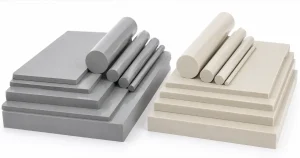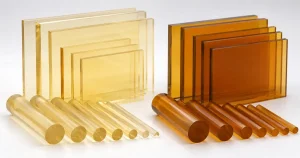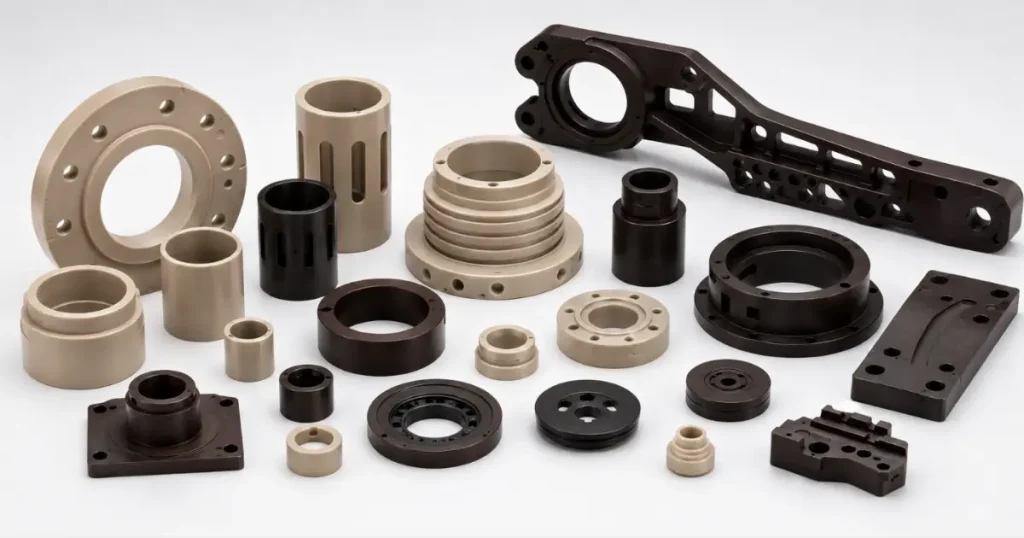
At Quanda Plastic, our specialized engineering materials—Sufoner® PEEK and Sufoner® PI Sheet & Rod—are trusted globally for critical custom-machined parts in nuclear facilities. Let’s explore how these materials exhibit stellar radiation resistance and how they contrast in nuclear applications.
Why Radiation Resistance Matters in Nuclear Engineering
Ionizing radiation causes polymer degradation through molecular chain scission or excessive cross-linking, which leads to embrittlement, loss of mechanical strength, and severe gas evolution. For structural parts, seals, electrical insulators, and connectors, material failure is not an option. Selecting plastics with stable aromatic ring structures in their backbone—such as PEEK and Polyimide—allows the material to absorb and dissipate radiation energy without disrupting its chemical matrix.
Sufoner® PEEK vs. Sufoner® PI: Technical Comparison
While both materials belong to the apex tier of engineering plastics, they offer distinctive performance envelopes under extreme radiation and temperature loads. Below is a detailed technical comparison optimized for custom non-standard nuclear components:
| Technical Properties | Sufoner® PEEK | Sufoner® PI (Polyimide) |
|---|---|---|
| Gamma Radiation Resistance (MGy) | Excellent (Up to 10 MGy / 10^9 rads) | Exceptional (Up to 100 MGy / 10^10 rads) |
| Continuous Service Temp. (°C) | 250°C to 260°C | 240°C to 300°C (Special grades up to 400°C) |
| Tensile Strength (MPa) | approx. 100 MPa | approx. 110 – 120 MPa |
| Outgassing under Vacuum | Extremely Low | Virtually Zero |
| Chemical & Hydrolysis Resistance | Outstanding (Highly stable in hot steam) | Excellent (Sensitive to strong bases/hot steam) |
| Primary Applications | Valve seats, back-up rings, cable wraps, sensors | High-dose structural insulators, core seals, alignment pins |
Custom Non-Standard CNC Machining Capabilities
Nuclear engineering rarely relies on off-the-shelf plastic parts. Most core components require precise tolerances, complex geometries, and custom non-standard dimensions. Quanda Plastic specializes in providing premium semi-finished materials as well as precision CNC machining. Whether you require bespoke dimensions derived from Sufoner® Polyimide rods or intricate structural matrices fabricated from Sufoner® PEEK sheets, our state-of-the-art facilities guarantee strict adherence to your rigorous industrial drawings.
Frequently Asked Questions (FAQ)
Q1: Can PEEK handle the extreme environment inside a nuclear reactor core?
A: Sufoner® PEEK is highly resilient against high radiation dosages up to 10 MGy and maintains excellent mechanical integrity. However, for positions directly exposed to the primary neutron flux inside the reactor core where radiation exceeds these limits, Sufoner® PI (Polyimide) is typically preferred due to its superior 100 MGy threshold.
Q2: Does radiation exposure alter the dimensional stability of Polyimide and PEEK?
A: Both Sufoner® PEEK and Sufoner® PI exhibit virtually zero outgassing and exceptional thermal stability, ensuring they maintain tight tolerances and dimensional integrity even after long-term radiation exposure.
Q3: Does Quanda Plastic supply custom non-standard machined parts according to specific drawings?
A: Yes, we provide full custom CNC milling, turning, and machining services for non-standard nuclear components based directly on our clients’ engineering designs and material requests.
Q4: How do these materials react to chemical cleaning solutions used in nuclear decommissioning?
A: PEEK has exceptional universal chemical resistance, making it immune to almost all common solvents and acids. Polyimide also possesses superior chemical resistance but should be evaluated carefully when exposed to highly alkaline chemical cleaning agents.
Looking for certified, high-performance radiation-resistant components for your upcoming nuclear project? Contact Quanda Plastic’s Engineering Team today to acquire custom quotes, material specifications, and expert guidance for all your non-standard high-performance plastic needs.