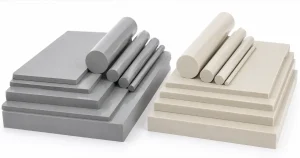
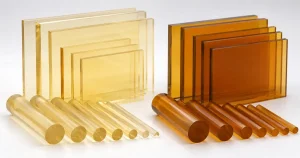
When engineering high-performance machinery, selecting the right material for non-standard, custom mechanical components is critical. Among engineering plastics, two titans dominate the power transmission landscape: Nylon (Polyamide) and POM (Polyoxymethylene, commonly known as Acetal).
Both polymers are renowned for their exceptional wear resistance and self-lubricating properties, but they behave vastly differently under mechanical stress, moisture, and operational loads. If you are designing or sourcing custom, wear-resistant gears, this definitive guide will break down the structural differences between Nylon vs. POM gears to help you make an data-driven choice.
Understanding the Competitors: Recalon® PA6/66 vs. Qunsail® POM
Before diving into specific gear mechanics, it is essential to look at the premium grades driving modern industrial applications:
- Recalon® PA6/66 (Nylon): Known for its extreme toughness, high impact fatigue resistance, and outstanding mechanical damping capabilities. It absorbs vibration and shocks better than almost any other engineering plastic.
- Qunsail® POM Acetal: Celebrated for its high rigidity, low friction coefficient, excellent dimensional stability, and superior resistance to creep and moisture absorption.
Key Performance Comparison for Wear-Resistant Gears
1. Wear and Friction Characteristics
Both materials are self-lubricating, making them perfect for dry-running gearboxes. However, Qunsail® POM exhibits a lower static and dynamic coefficient of friction than Nylon. It resists slip-stick effects brilliantly, ensuring ultra-smooth gear meshing. Recalon® PA6/66 Nylon, while slightly more abrasive in bone-dry environments, offers unparalleled abrasive wear resistance when subjected to particulate contamination or high-load friction.
2. Impact Strength and Load Capacity
If your non-standard gears are exposed to sudden shock loads or heavy cyclic fatigue (such as in start-stop industrial actuators), Recalon® Nylon is the clear winner. Nylon’s molecular matrix can absorb massive impacts without cracking. POM is stiffer and harder, but it is more sensitive to sharp notch impacts.
3. Dimensional Stability and Environmental Tolerance
This is where the paradigm shifts. Nylon is hydrophilic—it absorbs moisture from its surrounding environment, which causes slight volumetric expansion and alters mechanical clearances. If your custom gear requires tight tolerances (+/- 0.02mm) in humid conditions, Qunsail® POM Acetal is mandatory. POM absorbs virtually no water, ensuring its pitch circle diameter and tooth profile remain perfectly true over years of service.
Technical Comparison Matrix: Nylon vs. POM Gears
To assist engineering teams in evaluating physical parameters, here is a breakdown of key properties between Recalon® PA6/66 and Qunsail® POM Acetal:
| Technical Property | Recalon® PA6/66 Nylon | Qunsail® POM Acetal | Winner for Gears |
|---|---|---|---|
| Tensile Strength (MPa) | 80 – 85 (Dry) | 65 – 70 | Nylon |
| Coefficient of Friction | 0.35 – 0.42 | 0.25 – 0.32 | POM Acetal |
| Moisture Absorption (24h) | 1.5% – 2.5% (High) | < 0.2% (Minimal) | POM Acetal |
| Impact Strength (kJ/m²) | > 5.5 (Excellent) | ~ 6.0 (Moderate) | Nylon |
| Dimensional Stability | Moderate (Changes with humidity) | Outstanding | POM Acetal |
Tailoring Solutions for Non-Standard & Custom Gears
Standard industrial catalogs rarely meet the precise requirements of intricate machinery. Non-standard gears demand custom tooth profiles, specialized hub sizes, and exact dimensional machining.
At Quanda Plastic, we specialize in CNC machining and custom extrusion of high-grade plastic semi-finished shapes. Whether you need custom spur gears, helical components, or low-noise bevel gears, selecting the right raw stock shape (sheets or rods) makes all the difference. Check out our high-definition stock profiles for Recalon® PA6/66 Sheets and Qunsail® POM Rods to visualize your next project’s foundations.
The Verdict: Which One Should You Choose?
Choose Recalon® PA6/66 Nylon if:
- The gears will operate in highly abrasive environments or require severe shock-absorption.
- High static load capacity is needed, and the environment has managed or predictable humidity.
- Mechanical noise reduction (damping) is a primary engineering goal.
Choose Qunsail® POM Acetal if:
- The gears must maintain ultra-strict dimensional tolerances in wet, humid, or submerged environments.
- Continuous high-speed, low-friction, and zero-lubrication sliding performance are expected.
- You are machining precision non-standard gears with complex geometries that cannot afford warpage.
Frequently Asked Questions (FAQ)
Q1: Can Nylon and POM gears be used together in the same gearbox?
A: Yes! Mating a Nylon gear with a POM gear is an industry-best practice for non-standard gear trains. Since dissimilar polymers have lower friction coefficients when sliding against each other than identical plastics, running Nylon against POM significantly reduces wear rates and eliminates resonance noise.
Q2: How does temperature affect Nylon vs POM gears?
A: Nylon retains its mechanical properties at slightly higher continuous temperatures than POM. However, POM maintains much better dimensional tracking across thermal fluctuations, whereas Nylon may deform slightly due to combined thermal and moisture intake.
Q3: How can I order custom-dimensioned engineering plastic shapes for my gear manufacturing?
A: Industrial plastic selection requires specialized expertise. You can consult directly with our technical engineering team at Quanda Plastic. We provide optimized solutions based on your custom application blueprints. Visit our Contact Page to submit your specifications and request a tailored quote.