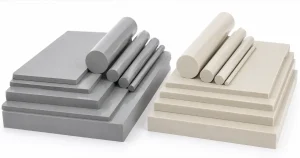
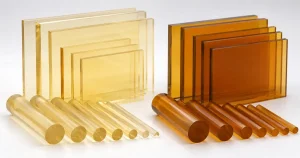
PMMA is a highly transparent amorphous thermoplastic with excellent optical properties. The light transmittance can reach 90%~92%, the refractive index is 1.49, and it can pass through most ultraviolet and infrared rays.
Performance of PMMA
Performance | Data | Performance | Data |
Relative Density | 1.17~1.19 | Heat distortion temperature(1.82MPa)/℃ | 115 |
Water Absorption/% | 2 | Long-term use temperature/℃ | 80 |
Tensile Strength/MPa | 55~77 | Linear expansion coefficient/(X10-5K-1) | 7 |
Tensile Modulus/MPa | 2400~2800 | Thermal conductivity/[W/(m·K)] | 0.14~0.2 |
Elongation at break/% | 2.5~6 | Volume Resistivity/Ω·cm | 1015 |
Bending strength/MPa | 110 | Dielectric constant (106Hz) | 2.2~2.5 |
Compressive Strength/MPa | 130 | Dielectric loss tangent (106HZ) | 0.02~0.08 |
Notched impact strength/(k]/m2) | 18~24 | Dielectric Strength /(kV/mm) | 20 |
Rockwell Hardness | M118 | Arc Resistance/s | No Leakage |
PMMA is a light and tough material, which has excellent tensile strength, bending strength and compressive strength at room temperature; but its impact strength is average, and its notch sensitivity is relatively high; Its surface hardness is average, easy to scratch, and its wear resistance is low, added to the poor silver streak resistance.
The oxygen index of PMMA is 17.3%. It is a flammable plastic, and it has a smell of flowers and fruits when burned; the heat-resistant temperature is not high, and the long-term use temperature is only 80°C.
Due to the large polarity in the molecule, its electrical properties are not as good as PE, and its dielectric constant is relatively large; it is mainly used as a high-frequency insulating material.
PMMA has good weather resistance and can be used outdoors for a long time.
The existence of ester groups in PMMA makes it generally resistant to solvents, but only resistant to alkalis, dilute acids and water-soluble inorganic salts, long-chain alkanes, oils, alcohols and gasoline, etc.; it is not resistant to aromatics and chlorinated hydrocarbons, and the specific varieties are tetrachloride. Carbon dioxide, benzene, xylene, dichloroethane and chloroform, etc.