Introduction to PTFE Film Turning Mechanics
Polytetrafluoroethylene (PTFE) is widely recognized in demanding industrial sectors—such as semiconductor testing, aerospace engineering, and chemical processing—for its extreme chemical inertness, superb dielectric insulation, and ultra-low coefficient of friction. However, transforming bulk sintered cylindrical PTFE billets into high-precision, thin-gauge films requires a highly specialized manufacturing methodology known as the skived turning process.
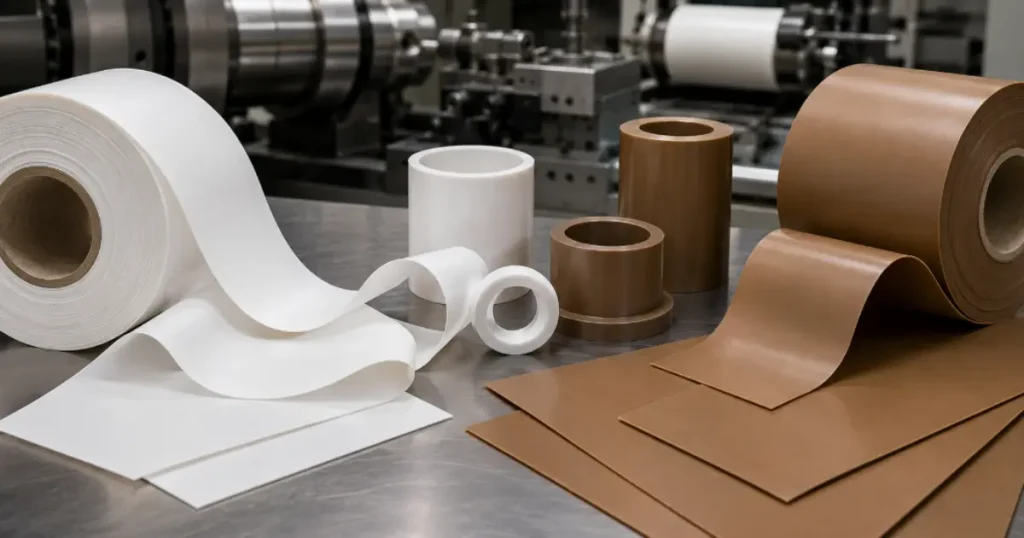
Unlike conventional metal lathe operations where material is selectively stripped away to form shafts or shoulders, the turning process of PTFE film involves rotating a molded, sintered polymer billet against a continuous, ultra-sharp linear blade. This micro-controlled rotary peeling mechanism allows manufacturers to achieve exceptional thickness uniformity in non-standard configurations.
Critical Challenges in Turning PTFE and Filled Compounds
While PTFE’s physical characteristics are highly advantageous for end-use components, they introduce unique hurdles during precision machining and skived turning:
- High Thermal Coefficient of Expansion: PTFE exhibits a thermal expansion rate roughly ten times greater than most metals. Heat generated during continuous turning can induce significant dimensional shifts, yielding uneven thickness across the film profile.
- Low Thermal Conductivity: Friction-induced heat does not quickly dissipate through the polymer core, focusing stress directly on the cutting edge and accelerating tool wear.
- Elastic Recovery and Elongation: High elongation properties mean that if the cutting force or tool geometry is suboptimal, the material will deflect under the blade rather than cutting cleanly, leaving microscopic ridges or surface deformations.
Optimizing Cutting Parameters & Tool Geometries
Overcoming the intrinsic volatility of fluoropolymers during skived turning dictates strict adherence to specialized machining parameters and specific cutter structures:
1. Cutting Tool Geometry
To prevent material deformation, blades utilized in the turning process must maintain an exceptionally keen cutting edge. High-Rake angles (typically between 12° and 20°) combined with generous clearance angles (10° to 15°) minimize tool-to-workpiece friction, cutting cleanly through the elastomer without drag. Polished carbide or Diamond-Like Carbon (DLC) coated tools are standard to eliminate material build-up.
2. Rotational Speed (Feed Rate Optimization)
Linear speeds must be dynamically modulated relative to the shrinking outer diameter (OD) of the primary billet. Consistent surface speed (SFM) ensures that the film experiences an identical tensile drag from the tensioning roller throughout the entire manufacturing run, mitigating gauge variations.
3. Continuous Thermal Regulation
Employing constant, high-volume air cooling or application-compatible water-soluble coolants is vital to stabilize the structural matrix at the shearing interface. Maintaining temperatures below the critical crystalline phase change window (~19°C to 23°C) preserves predictable dimensional outcomes.
Technical Comparison: Unfilled PTFE vs. Filled Compounds (Rulon & Carbon-Filled)
The specific compound matrix altered during sintering severely impacts the turning process. To aid engineers in choosing the precise specification for their non-standard designs, the table below provides a comprehensive comparison of technical metrics across common skived films:
| Material Grade | Key Additives | Turning Machinability | Min. Thickness Achievable | Primary Application Domain |
|---|---|---|---|---|
| Virgin PTFE Film | None (100% Pure) | Excellent; requires high blade sharpness to prevent elongation. | 0.03 mm | Semiconductor testing insulations, chemical diaphragms. |
| Rulon / Proprietary Filled Film | Silicates / Custom Fibers | Moderate; abrasive fillers increase cutter wear. Requires heavy cooling. | 0.05 mm | Heavy-duty automotive seals, non-lubricated bearings. |
| Carbon / Graphite Filled PTFE | 10% – 15% Carbon Powder | Good; improves thermal dissipation during cutting. Low burr creation. | 0.04 mm | Anti-static aerospace liners, dynamic friction pads. |
Custom Non-Standard Customization Capabilities
At QUANDA, we recognize that off-the-shelf polymer components rarely satisfy the rigorous requirements of cutting-edge engineering fields. Our advanced industrial skived lathes and CNC turning centers specialize in fabricating non-standard, custom-tailored PTFE profiles.
Whether your assembly requires micro-gauge films with narrow tolerances down to ±0.002mm, custom chemical-etched surfaces for structural bonding, or proprietary filled formulations designed to endure extreme tribological strain, our engineering department works meticulously to execute your exact blueprint specifications.
Frequently Asked Questions (FAQ)
Q1: How does ambient temperature affect the turning precision of PTFE film?
A1: Because PTFE undergoes a distinct volume and crystalline phase transition around 19°C to 23°C, any minor shift in ambient workshop temperature can induce material expansion or contraction. At QUANDA, our CNC turning and skiving facilities maintain rigid environmental stabilization to guarantee absolute dimensional fidelity.
Q2: What are the benefits of choosing skived turning over extruded manufacturing for thin films?
A2: Skived turning allows for much thinner gauges without introducing mechanical stress lines common in extrusion. It also permits the conversion of highly compressed, high-molecular-weight compression-molded billets, yielding superior tensile strength and structural integrity in the resulting film.
Q3: Can QUANDA produce non-standard filled PTFE films according to custom technical drawings?
A3: Yes. We are a specialized manufacturer of non-standard components. We process custom orders combining diverse compound fillers (Glass fiber, Carbon, Graphite, MoS2, Rulon alternatives) matched with precision slicing, stamping, or multi-axis turning down to specific client criteria.